
Legal Education
The practice of law is changing rapidly, responding to pressure from changing economic, technological, and regulatory landscapes. New providers are entering the market, new businesses are organizing to offer legal services, and technology is fundamentally altering how lawyers engage with their work and clients. Meanwhile, the legal profession fails to serve millions of regular people and small businesses who are unable to find or afford the services of a lawyer. Throughout these massive shifts, the tenets of ethical legal practice–confidentiality, professional independence, and care–remain paramount. But how to ensure that legal ethics are taught in ways that are accessible and effective and that reflect the reality of modern legal practice?
Founded by one of the most highly respected legal ethics scholars, the Rhode Center is leading the way in developing better pedagogical practices to teach legal ethics: practices rooted in a common sense understanding of social and legal issues and grounded in specific substantive points of view. Responding to traditional critiques of legal ethics education–that it is either entirely rote memorization of the professional conduct or a philosophical exercise–the Center is developing a new approach that is explicitly tied to the ethical rules but also deeply practical, embedding students in real practice experience and subject matter areas through which they consider and apply legal ethics. The approach also directly engages with and develops deep critiques of the ethical framework itself–challenging the role of the ethical rules in institutionalizing and sustaining the elite bar at the expense of the public and individual litigants.
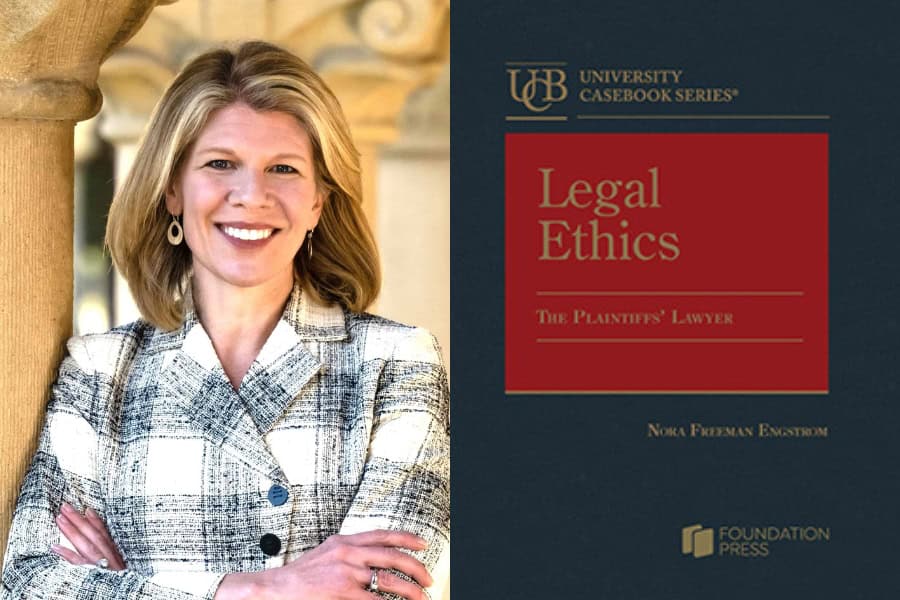
Legal Ethics: The Plaintiffs’ Lawyer
Professor Nora Freeman Engstrom’s groundbreaking course and casebook use a study of plaintiffs’ lawyers as a vehicle to explore many of the most controversial and important issues at the intersection of tort law, civil procedure, and legal ethics. Specifically, the curriculum studies who personal injury lawyers are, how they find clients, how they fund litigation, and how they usher complex cases to conclusion.
In so doing, Engstrom addresses:
- the role and regulation of lawyers;
- the use and abuse of the contingency fee;
- the legality and normative consequences of solicitation and attorney advertising;
- the propriety of secret settlements, NDAs, and expansive protective orders;
- the rise and impact of “alternative litigation finance”; and
- the vexing issues posed by class actions, aggregate actions, consolidated actions, and multidistrict litigations (MDLs).
Finally, using a series of case studies, students test their knowledge of the Model Rules of Professional Conduct and have the opportunity to see the key themes echoed and expressed in recent real-world controversies. Importantly, though the course and casebook are nominally focused on “the plaintiffs’ lawyer,” they do not just equip students to practice on one side of the “v.” Rather, through Engstrom’s grounded and contextualized study of legal ethics, advanced civil procedure, the modern legal profession, and contemporary legal practice, students will acquire tools to litigate cases of all stripes and for both sides.
Access to Justice: Law, Policy, and Legal Ethics
The American civil justice system sits at a crossroads. In three-quarters of the 20 million civil cases filed in state courts each year, at least one side lacks a lawyer. Many are significant, even life-altering moments: debt disputes, evictions, domestic violence, a former partner behind on child support, an employer refusing to pay overtime, or an insurer who denies a legitimate claim. Beneath those cases sit tens of millions more legal problems that never make it to court. Such large, systemic gaps in access to legal services limit who can vindicate their rights, magnifying disparities based on income, education, race, gender, and ethnicity. The future of the civil justice system, and the legitimacy of the courts at its center, will turn on how—and how well—judges, court administrators, the legal profession, and an array of policymakers respond to these new realities.
Professor David Freeman Engstrom and former Rhode Center Civil Justice and Innovation Fellow Todd Venook are the developers of a first-of-its-kind lecture course and related forthcoming casebook offering a wide survey of the current state of access to civil justice in the United States. The project considers the long-run causes and consequences of the justice gap and the major features, constituencies, and stakeholders of the state court systems that are struggling to close it. The curriculum tours and assesses potential solutions—from procedural simplification, to revived Due Process, to new technologies, to legal ethics reform. Throughout, students consider the complex ethical rules that govern lawyers and lawyering and investigate whether and how these rules contribute to, and might instead ameliorate, the access-to-justice crisis. Ultimately, students will emerge with a synoptic understanding of one of the most pressing challenges to the legitimacy of the American legal system, along with new ideas about how to chart a career devoted to access to justice.