
The Future of the Law Firm
The Rhode Center has launched The Future of the Law Firm Initiative to critically examine and illuminate the convergence of capital, technology, and talent that is reshaping the legal profession. Through interdisciplinary research, strategic partnerships, and industry engagement, we seek to equip future leaders, inform policy and regulation, and contribute to a legal system that is more innovative and accessible, while remaining faithful to its core ethical principles.
Watch the CodeX FutureLaw 2026 Opening Keynote: The Future of the Law Firm
Mapping the Convergence of Capital, Technology & Talent
The legal system is on the cusp of massive change. Artificial intelligence is transforming the way lawyers work and redefining how they deliver value. Private capital has entered the business of law through alternative business structures and managed services organizations. The law firm talent pipeline is increasingly a mix of human and AI workforces.
Across these evolving trends, three core questions emerge:
- How will law firms create and deliver value?
- Who will benefit from and capitalize on these changes?
- Will law remain a fiduciary institution?
The Future of the Law Firm Initiative seeks to add empirical insight to these questions through a variety of interconnected research efforts and convenings.

Empirical Inquiry into AI-Native Law Firms
A small but growing number of law firms are positioning themselves as “AI native.” The Rhode Center on the Legal Profession and the Legal Innovation through Frontier Technology Lab (liftlab) at Stanford Law School are partnering to conduct research to better understand this growing subset of law firms. Through interviews with key stakeholders, we seek to scratch the surface on these emerging, and rapidly proliferating, practice structures. We also seek to develop—if/where possible—an analytical framework for thinking about these firms across various aspects of law practice: business model; service model; talent/team; technological architecture; data strategy; entity structure; external capital; governance and ethics; and others.
Research on & Best Practices in Law Firm-Private Equity Partnerships
An increasing number of states are departing from traditional legal services, launching innovative reforms that permit entities to provide legal services in ways that would normally be prohibited.
- Arizona removed restrictions on who may own law firms and share fees with lawyers, permitting alternative business structures (ABSs).
- Utah authorized nonlawyer ownership and relaxed unauthorized practice of law restrictions on who (nonlawyers) and what (software) may practice law by creating a legal regulatory “sandbox.”
- Puerto Rico authorized ABSs under certain circumstances.
- Washington established an Entity Regulation Pilot Project, allowing businesses and nonprofits with innovative service models to operate outside current regulatory limitations under carefully monitored conditions.
The Rhode Center, through the Legal Innovation After Reform series, continues to examine these state efforts, to shed light on what innovations are emerging through these programs and who is being served.
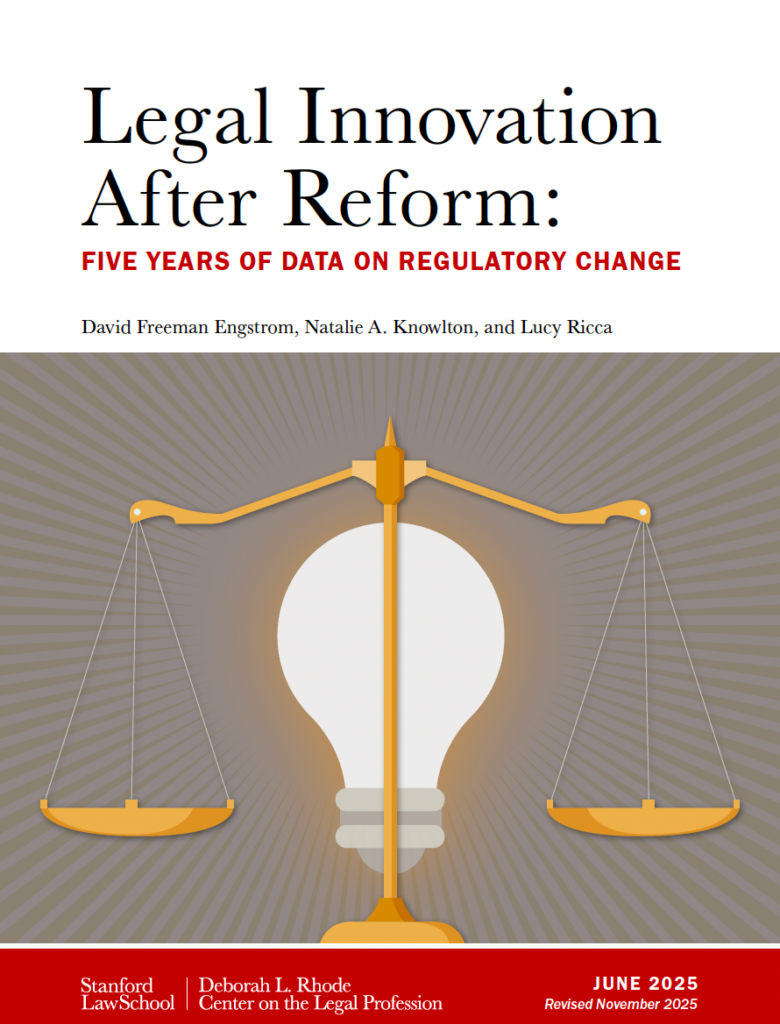
At the same time, outside of these first-mover states, law firms are increasingly seeking partnerships with managed services organizations (MSOs), which split the practice of law and the business of law, allowing private investment in the latter. As these new business and service models proliferate, the Rhode Center is partnering with industry and law firm stakeholders to outline best practices in shaping these arrangements.
Future of the Legal & Medical Professions Symposium: October 2026
Law and medicine are navigating many of the same challenges. Disruptive technologies, shifting markets, and an evolving policy landscape are reshaping how each profession operates. Stanford Law School, the Rhode Center, and the Stanford School of Medicine are co-hosting a special symposium on the future of the legal and medical professions on October 26, 2026. This full-day symposium brings together leaders, scholars, and practitioners from Stanford, peer institutions, and industry for a cross-disciplinary conversation about these shared concerns. Together, we’ll explore what law and medicine can learn from each other as the sister professions prepare for the decade ahead.