
The Claim Integrity Initiative
Contrary to popular perception, the civil litigation system is shrinking, not growing out of control: tort filings have decreased, jury trials are rare, and the vast majority of claims are genuine and meritorious. Yet two corners of the tort system stand as important exceptions to the general rule: mass tort litigation and certain soft-tissue auto claims. Critically, in both these domains, the financial incentives that generally encourage plaintiffs’ lawyers to screen claims carefully become weakened or distorted.
The Claim Integrity Initiative, led by Rhode Center Co-Director and Stanford Law School Professor Nora Freeman Engstrom, takes a targeted, evidence-based approach to this problem. The Initiative has two arms: one seeks to address the problem of nonmeritorious claims in MDLs; the other focuses on inflated claims in “traditional” personal injury practice. Each combines action, research, and exploration—advancing a flagship reform, building the evidence base for intervention, and developing new solutions.
The MDL Pillar: Limiting Nonmeritorious Claims
Large mass tort MDLs reward volume over vetting: filing a claim costs little, and coveted leadership roles sometimes flow to the lawyers with the largest client “inventories.” Judges can try to cull bad claims one by one, but this vetting is time-consuming and costly—and, even if the judge succeeds, the firm can rinse and repeat in the next MDL. What’s needed is a tool not merely to screen claims, but to shift incentives.
Action: sliding-scale common benefit fees
We propose replacing the flat common benefit fee “tax” every MDL firm pays with a sliding scale tied to screening performance. Careful screeners pay less; docket-flooders pay more.
Research
The oft-repeated numbers on bogus claims rest on almost no systematic evidence. Using docket mining and machine learning, we will build the first real dataset to assess their prevalence and identify which kinds of MDLs are especially prone to these filings.
Exploration
Sliding-scale fees are one possible reform lever, but other reform ideas also hold promise. Our convenings and research will surface and pressure-test others.
The Transparency Pillar: Curtailing Inflated Claims
In everyday personal injury practice, many claims settle with insurers before a lawsuit is ever filed. Courts, and the tools they have to pressure-test filings, never enter the picture. In this realm, settlement values often rise alongside claimed medical expenses. That fact gives unscrupulous firms, paid via a contingency fee, a financial incentive to artificially inflate medical expenses, engaging in what’s called “medical buildup.” These inflated claims are costly and corrosive. They raise all motorists’ insurance premiums; distort settlement negotiations; sometimes, pressure unsuspecting victims into unnecessary care; and undermine public confidence in the broader personal-injury ecosystem.
Action: closing statements
We propose a simple disclosure requirement. At the end of every contingency-fee representation, lawyers would report basic information about the claim, including the client’s claimed economic losses, gross recovery, and attorney’s fee. Individual reports would remain confidential, but aggregate firm-level data would be made public. Because firms that systematically inflate medical expenses tend to generate unusually low recoveries relative to claimed losses, those patterns would become visible—allowing clients, insurers, regulators, and others to identify firms whose claims appear routinely inflated. Essentially, fueled by closing statements, reputational pressure can do some of the policing that courts can’t.
Research
We will draw on new sources to document origins of medical buildup and how to address it.
Exploration
We will investigate and consider further reforms the research surfaces.
Publications
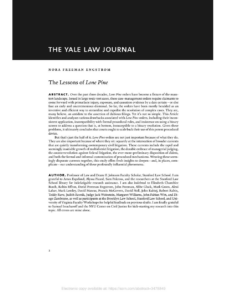
The Lessons of Lone Pine
by Nora Freeman-Engstrom
The Yale Law Journal, 2019
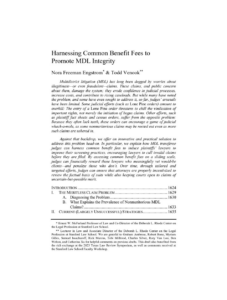
Harnessing Common Benefit Fees to Promote MDL Integrity
by Nora Freeman-Engstrom & Todd Venook
Texas Law Review 2023
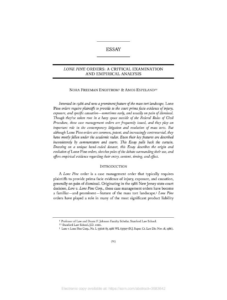
Lone Pine Orders: a Critical Examination and Empirical Analysis
by Nora Freeman-Engstrom & Amos Espeland
University of Pennsylvania Law Review Online, 2020
Retaliatory RICO and the Puzzle of Fraudulent Claiming
by Nora Freeman-Engstrom
Michigan Law Review, 2017
Shining a light on shady personal-injury claims
by Nora Freeman-Engstrom
Journal of Insurance Fraud in America, 2011
Sunlight and Settlement Mills
by Nora Freeman-Engstrom
New York University Law Review, 2011