Transparency in Litigation
How much, if at all, should litigation proceedings, and the underlying facts illuminated therein, be protected from public scrutiny? What is the appropriate balance between litigants’ privacy interests, the rights of the public, and the media, to know about issues impacting public health and safety, and the role of “open courts” as a cornerstone of American law?
These questions have been the subject of heated debate, by academics, policymakers, and trial lawyers, for decades. The stakes are not theoretical. In the past, the tools of secrecy—protective orders, sealed settlements, and confidentiality agreements—have concealed many far-reaching harms from the public: rifles that misfire, defective heart valves, dangerous opioids, faulty contraceptive devices, and the predatory behavior of high-profile individuals such as Harvey Weinstein, Bill Cosby, Jeffrey Epstein, and Bill O’Reilly. Recent state efforts to increase transparency, including in California, have spurred these debates to new levels of prognostication.
These debates suffer from a severe lack of empirical evidence. Basic questions go unanswered. Does limiting non-disclosure agreements (NDAs) increase litigation? How common are stipulated protective orders approved by the court? What effect do laws limiting secrecy in litigation actually have?
The Rhode Center’s project on Transparency in Litigation is answering these questions. Using first-of-its-kind rigorous empirical research on vast datasets pulled from both federal and states courts, the Center is bringing much needed evidence and academic discipline to these arguments in the courtroom and in the hallways of the legislatures.
Our Work
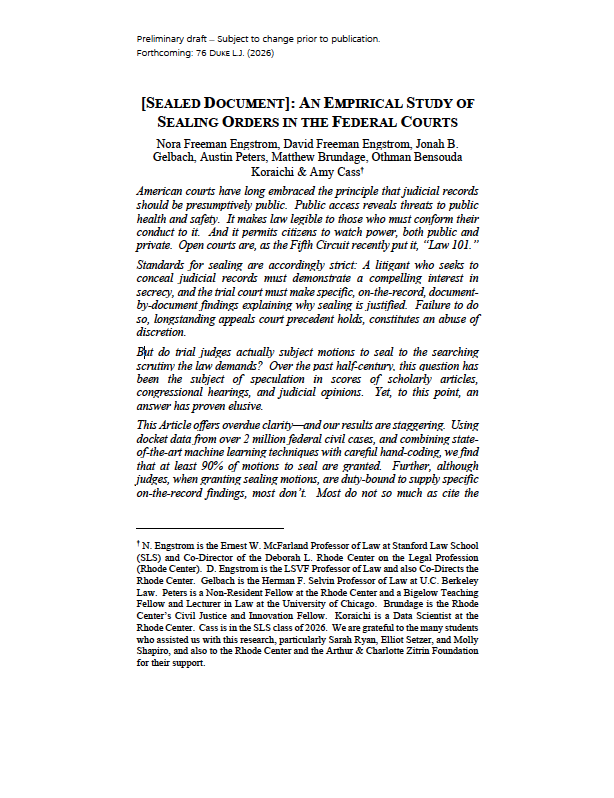
[Sealed Document]: An Empirical Study of Sealing Orders in the Federal Courts
[Sealed Document]: An Empirical Study of Sealing Orders in the Federal Courts examines the frequency with which courts grant motions to seal. Though standards for sealing judicial records are strict, our research finds that at least 90 percent of motions to seal are granted. Further, although judges, when granting sealing motions, are duty-bound to supply specific on-the-record findings, most do not.
Secrecy by Stipulation
Secrecy by Stipulation examines the frequency with which courts grant protective orders stipulated to (agreed to) by the parties. Though courts have a duty to carefully scrutinize and independently evaluate the necessity of these orders, our research finds that they rarely do so. In fact, we found that federal judges granted 95 to 97 percent of these stipulated orders, often without comment.

Shedding Light on Secret Settlements: An Empirical Study of California’s STAND Act
Shedding Light on Secret Settlements: An Empirical Study of California’s STAND Act focuses on secret settlements and the accompanying NDAs and confidentiality agreements used to great effect by powerful abusers in sexual harassment, sexual assault, and workplace discrimination claims. Empowered by #MeToo, the California legislature enacted two major pieces of legislation with the intended effect of prohibiting such secret settlements in these kinds of cases. Our research sought to look at the impact of these policy changes on the initiation, duration, and intensity of litigation on these issues. Analyzing 262,000 case filings from Los Angeles County, we found, contrary to the arguments of opponents of the legislation, only a slight decrease in filings and no impact on litigation duration or intensity.

Our Team


Media
The Litigation Transparency Project: Rhode Center Project Shines a Light on Secret Settlements and Protective Orders
By Garrett M. Wen, JD ’24, and Aaron Schaffer-Neitz, JD ’24, in Stanford Lawyer

New Data on an Old Problem: Stanford’s Nora and David Freeman Engstrom Discuss their Study on Protective Orders and Court Secrecy
By Nora Freeman Engstrom David Freeman Engstrom in Stanford Lawyer