Our Innovative Partnership with LA Superior Court
In recent decades, a rising tide of small-scale but high-stakes cases has come to dominate state court dockets, including debt collections, evictions, home foreclosures, and certain family law matters. Most pit an institutional plaintiff (a bank, debt buyer, corporate landlord, or the government), always with a lawyer, against an individual defendant without one. Pervasive asymmetries across the two sides of the “v” predictably produce high rates of default by overmatched defendants, overwhelm judges and court staff, and yield outcomes that diverge from legal merit.
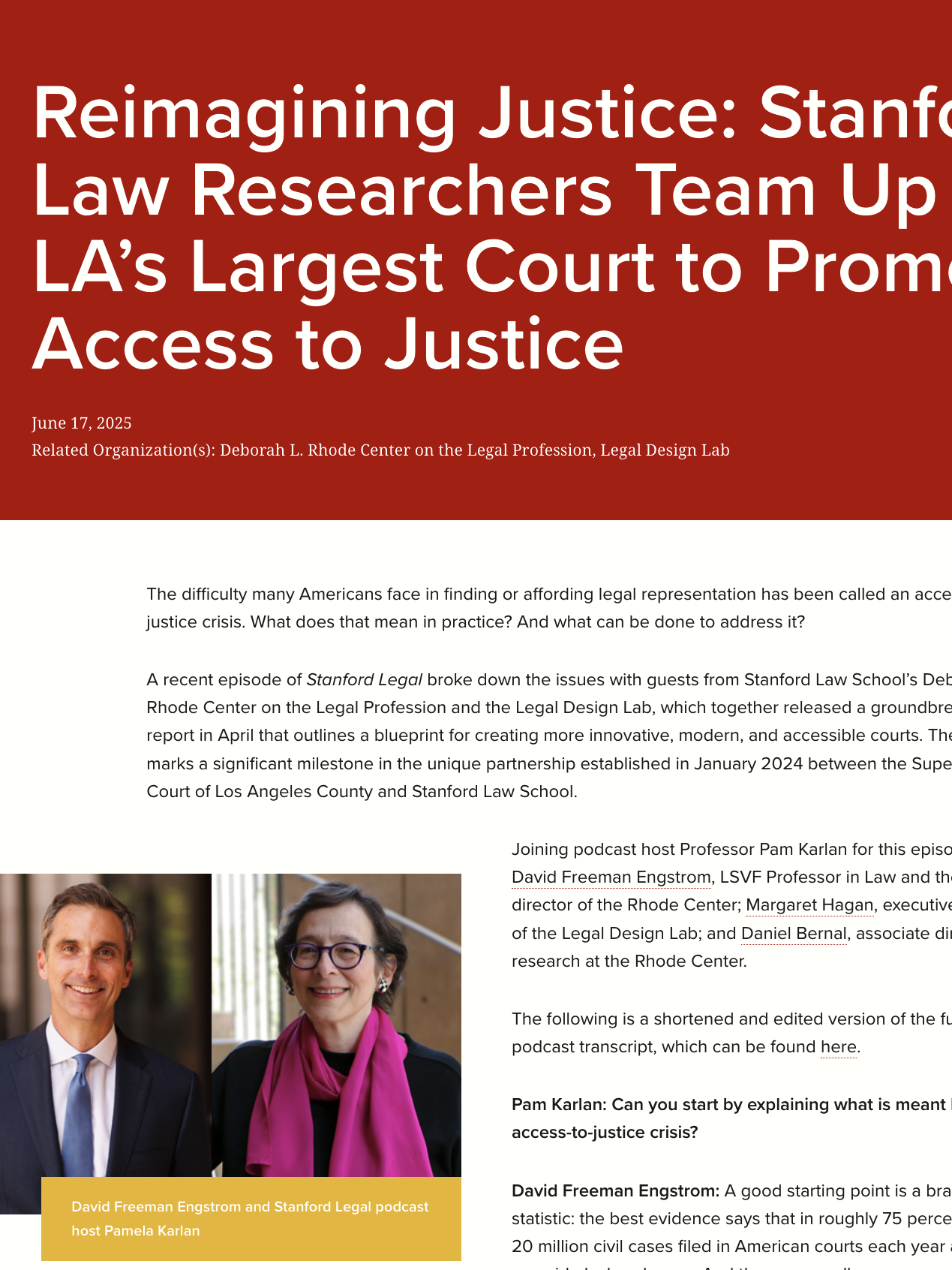
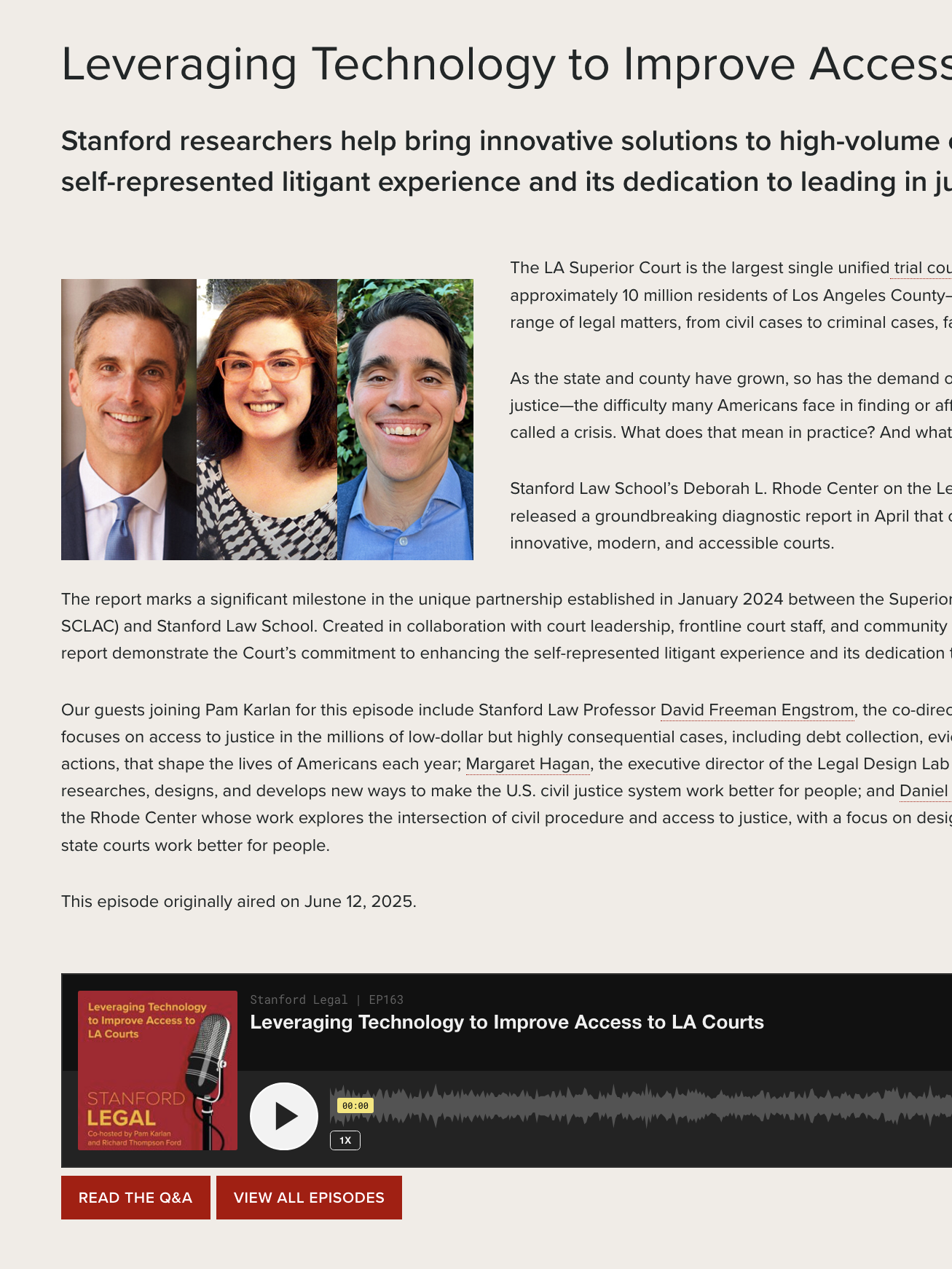
The Rhode Center and Legal Design Lab are partnering with the LA Superior Court (“LASC”), the nation’s largest, to design, implement, and rigorously evaluate new approaches at the frontiers of innovation. This first-of-its-kind partnership, which began in 2024, has three core objectives:
- Identify systemic and sustainable ways to promote meaningful access for court users, particularly those without legal representation.
- Support the Court, judges, and staff in their core mission of resolving disputes in fair, accurate, and efficient ways.
- Build the evidence base–through experimentation, evaluation, and data–about which interventions meaningfully improve access to justice and court performance, and which do not.
Challenges and Opportunities in LASC’s Eviction Docket
Landlords in the U.S. file upwards of 3.5 million evictions each year. In California, evictions displace 500,000 tenants annually, and, in Los Angeles County, some 47,000 eviction cases were filed in 2023 alone. In a large number of these cases, tenants fail to respond despite viable defenses that could delay or prevent displacement, with rippling consequences for housing and family stability, employment, and health that fall most heavily on vulnerable populations.
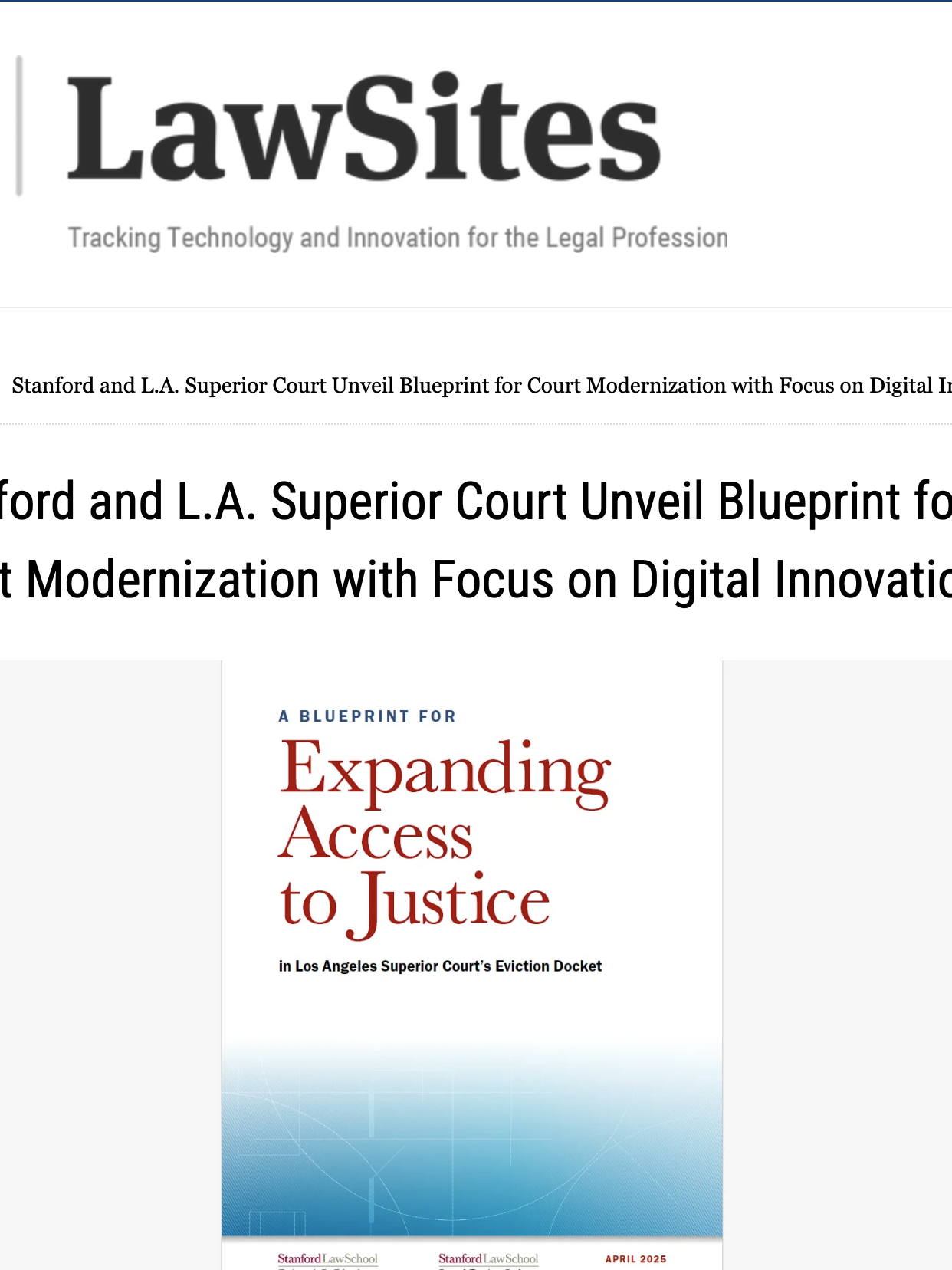
During an initial, diagnostic stage of the partnership with LA Superior Court, the Stanford team studied barriers to court engagement, focusing, as a point of entry, on eviction cases. Our report, A Blueprint for Expanding Access to Justice in Los Angeles Superior Court’s Eviction Docket, offered an unprecedented, data-based view of the Court’s eviction dockets.
Watch the Webinar: A Blueprint for Expanding Access to Justice in LA Superior Court’s Eviction Docket
Frontiers of Justice Innovation in LA Superior Court
Based on our findings, the Stanford team proposed reforms along four frontiers of justice innovation and identified the initial steps the Court might take within each.
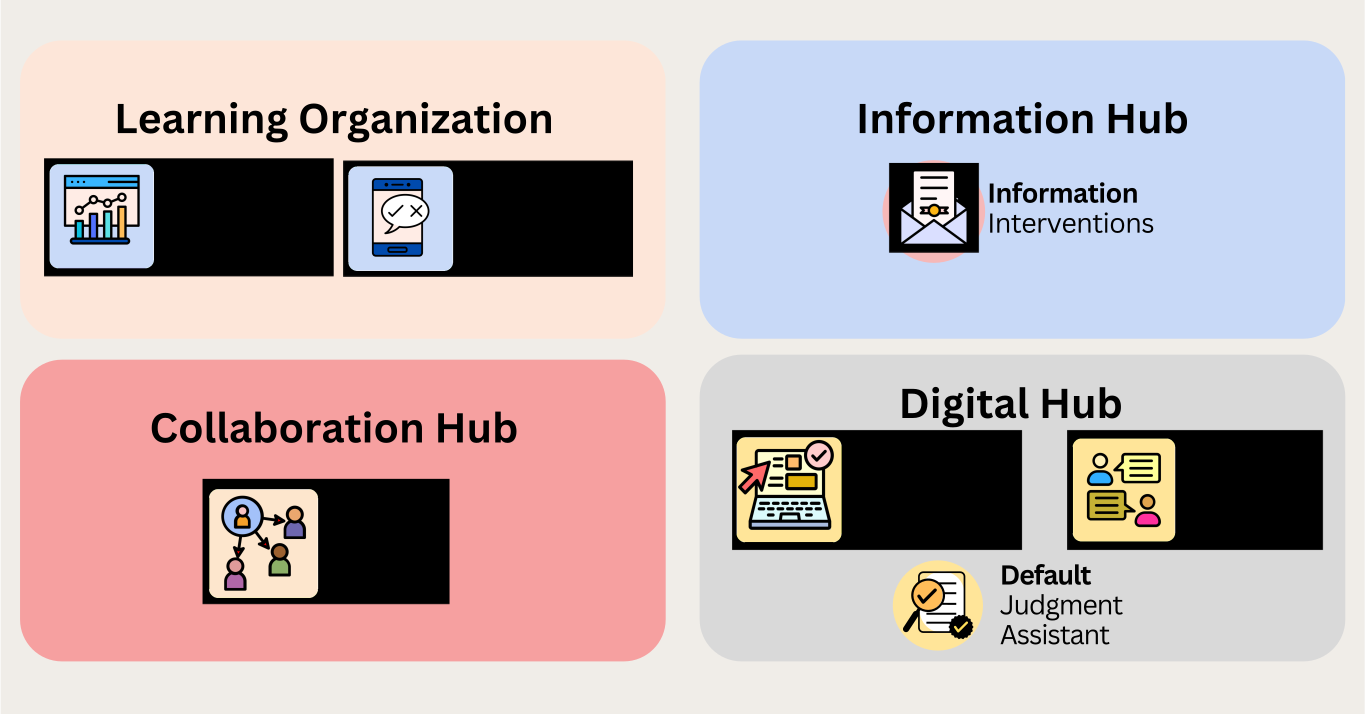
We are now working with the Court to design and implement several high-impact recommendations and then evaluate them with gold-standard research designs.
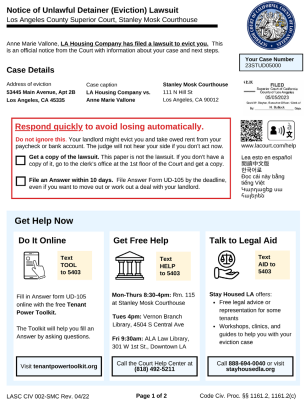
Informational Interventions: The Court’s Unlawful Detainer (UD) Notice, sent to the defendant in every eviction case, is often the starting point for a tenant’s decision whether to participate in the case or, instead, to default. Yet our interviews and focus groups identified challenges with the UD Notice that may be impacting litigants’ ability to understand what is happening, where to find help, and how to take action in their case. Our Stanford team revamped the UD Notice, fortifying it with plain, action-oriented language, QR-linked access to case materials, access to an online form-filling tool, and accompanying text message reminders. A multi-arm, randomized controlled trial (RCT) of these innovations will offer a gold-standard test of longstanding but mostly untested hypotheses about whether and how informational interventions can reach self-represented litigants.
Referral Routing Tool: Tenants who choose to participate in their eviction case often stumble through the complex landscape of self-help and legal help resources available at the Court and in the community. Court staff, too, are at capacity and are uncertain about what help they can provide to litigants, with requests for referrals to legal help as a particular pain point. We are partnering with the Court to develop a new AI-based, court-hosted Referral Routing Tool that engages with litigants and then provides them tailored and appropriate legal help options, including guidance on accessing them.
Default Judgment Assistant: Deployment of court staff to check a debt collection plaintiff’s request for default judgment for legal defects already sets LASC apart as a national leader. But default judgment review is labor-intensive and imperfect. Potent new technologies can identify more invalid default requests while dramatically reducing the time and resources spent. The Stanford team has developed an AI-based “default judgment assistant” to augment, not replace, human review. By freeing staff capacity and improving issue-spotting, the tool will enable more consistent, thorough, and accurate compliance review, reducing the number of legally unwarranted judgments that lead to unfair wage garnishments and undermine housing and family stability.
Online Dispute Resolution: Online dispute resolution (ODR) systems have long promised a more accessible, efficient, and user-centered approach to adjudication, particularly for high-volume civil disputes. In practice, however, many ODR implementations have fallen short—replicating existing procedural barriers in digital form, failing to meaningfully engage users, or operating in isolation from courts’ core adjudicatory functions. An innovative new partnership with the Los Angeles Superior Court and ODR.com aims to design, build, and rigorously test a next-generation ODR system that is responsive to litigant capacities and fully integrated into court operations. The project seeks not only to resolve disputes more efficiently, but to strengthen accuracy, participation, and trust in adjudication.